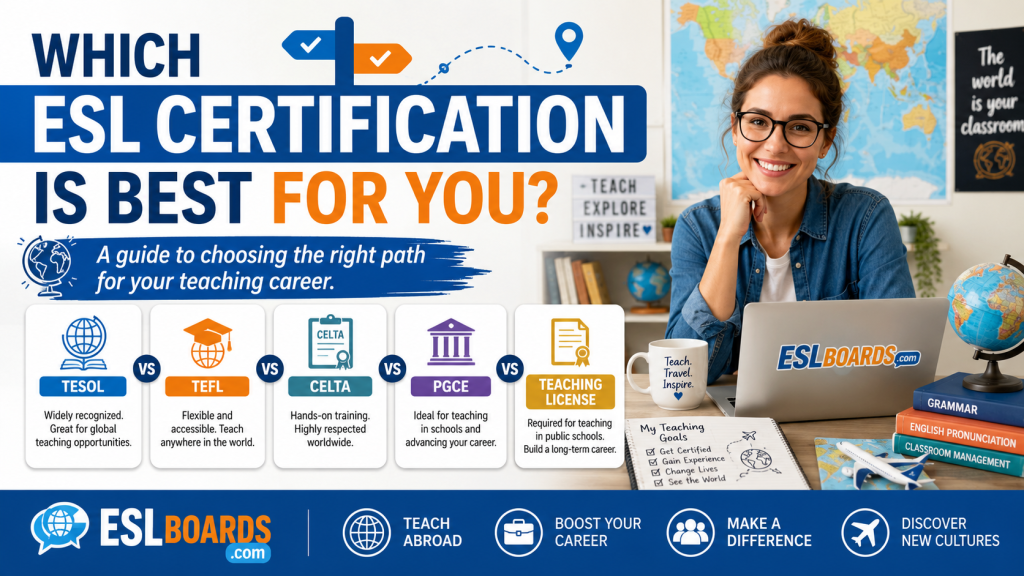
“Which ESL certification should I get?” is the single most common question aspiring English teachers ask — and the most frustrating to answer, because the honest response is always “it depends.” It depends on your budget, your target country, whether you see teaching as a gap year or a career, how much time you can commit, and which doors you want open five years from now. This guide cuts through the noise and gives you a clear decision framework so you can choose the certification that fits your situation rather than the one with the best marketing.
If you want the detailed comparison, read our TEFL vs TESOL vs CELTA deep dive. This guide is the practical companion: a step-by-step way to land on the right answer for you. Browse the full Certifications section for guides to each individual qualification.
Start With the Right Question
Most people ask “Which certification is best?” as if there’s an objective ranking. There isn’t. The better question is: “Which certification best fits my goals, budget, and timeline?” The answer depends on four factors, which we’ll work through in order.
- What do you want to do, and where?
- What’s your budget?
- Is this a career or a short-term experience?
- How much time can you commit?
Factor 1: What Do You Want to Teach, and Where?
Your target market is the single biggest determinant. Different regions and employer types have different baseline expectations.
| Target | Typical Minimum Qualification |
|---|---|
| Language centers / hagwons in East & SE Asia | 120-hour TEFL/TESOL |
| Public school programs (EPIK, JET, NET) | 100–120 hour TEFL (some in-class hours) |
| Latin America (Mexico, Colombia, Brazil, etc.) | 120-hour TEFL/TESOL |
| Online platforms (entry-level) | 120-hour TEFL/TESOL |
| Western Europe (Spain, Italy, Germany, France) | CELTA or Trinity CertTESOL strongly preferred |
| Middle East (UAE, Saudi Arabia, Qatar) | CELTA minimum; DELTA/MA/PGCE for top salaries |
| British Council, International House | CELTA or Trinity CertTESOL |
| Universities (foundation / IEP) | CELTA + experience; MA or DELTA preferred |
| International schools (British, IB, American) | PGCE/QTS or home-country teaching license |
The pattern is clear: TEFL/TESOL is the baseline everywhere; CELTA is the premium tier; PGCE/DELTA/MA unlock the elite tier. If you’re not sure where you want to teach yet, a CELTA keeps more doors open than a TEFL.
Factor 2: What’s Your Budget?
Be realistic about what you can spend. There’s no point going into debt for a CELTA if you only need a TEFL — and no point saving $300 on a cheap TEFL if it locks you out of the jobs you want.
| Budget | Realistic Option |
|---|---|
| Under $400 | Accredited 120-hour online TEFL/TESOL (budget providers like UNI-Prep, MyTEFL; or sale prices from larger providers) |
| $400–$1,000 | Strong accredited 120–168 hour online TEFL/TESOL or Level 5 course from a reputable provider |
| $1,000–$2,000 | Combined online+practicum course, or a regional in-class TEFL |
| $1,500–$3,000 | CELTA or Trinity CertTESOL (the premium entry-level tier) |
| $3,000–$6,000 | DELTA (for experienced teachers) |
| $9,000+ | PGCE or MA TESOL (major career investment) |
See our full breakdowns of TEFL costs and the CELTA guide for what’s included.
Factor 3: Career or Short-Term?
This shapes everything. Be honest with yourself.
If it’s a gap year, a one-to-two-year experience, or a stepping stone
A 120-hour accredited TEFL/TESOL is almost always the right call. It’s affordable, it’s accepted by the vast majority of entry-level employers, and you won’t feel bad walking away from a $500 investment if you decide teaching isn’t for you. Don’t overspend on a CELTA if you’re not sure you’ll stay in the field.
If you’re committing to English teaching as a long-term career
Invest in credentials that won’t need replacing. CELTA is the safest starting point because it’s recognized everywhere and feeds directly into the DELTA pathway. Plan for CELTA now, a few years of teaching, then DELTA or a PGCE/MA depending on direction. Over a 10–20 year career, the upfront premium is trivial compared to the salary and mobility it unlocks.
If you already have teaching experience or a related background
A licensed teacher, an education graduate, or a non-native speaker with a linguistics degree may be able to skip straight to higher-level qualifications. See teaching without experience and minimum requirements to map where you stand.
Factor 4: How Much Time Can You Commit?
- Flexible, self-paced, study around a job: Online TEFL/TESOL (4 weeks–6 months).
- Can do 4 intense full-time weeks: CELTA or an in-class TEFL intensive.
- Want to study over a year part-time: Part-time CELTA, or spread a Level 5 TEFL out.
- Can commit 1–2 years: PGCE, DELTA (part-time), or MA TESOL.
CELTA’s intensity is real — read our CELTA guide before committing to a full-time course.
Decision Frameworks for Common Situations
Scenario A: “I want to teach in Asia for a year or two.”
Answer: A 120-hour accredited online TEFL, $300–$800. Add an in-class component only if you’re targeting China or want EPIK in-class hours. Pair it with our job-search guide.
Scenario B: “I want a long-term ESL career and maximum mobility.”
Answer: Start with CELTA ($1,800–$2,800). Teach for 2+ years. Then pursue DELTA if you want to train teachers or manage, or a PGCE/MA if you want international schools or universities.
Scenario C: “I want to teach in Spain/Italy/Germany/France.”
Answer: CELTA. Western European schools strongly prefer it, and competition is fierce. A TEFL may get you informal academy work, but CELTA opens the better employers.
Scenario D: “I want the best-paid Middle East job I can get.”
Answer: CELTA minimum, plus 2+ years of solid experience. For the top salaries, add a DELTA, MA TESOL, or PGCE/QTS. See the Middle East entries in our country guides.
Scenario E: “I want to teach online from home.”
Answer: A 120-hour accredited TEFL is enough for almost all platforms. Premium platforms and direct-freelancing clients pay more if you add a CELTA and a specialization (business English, IELTS). See freelancing as an ESL teacher.
Scenario F: “I want to teach at an international school abroad.”
Answer: A teaching license — for UK-aligned schools, a PGCE with QTS. TEFL and CELTA alone won’t get you into international schools. Read our PGCE guide.
Common Mistakes to Avoid
- Buying the cheapest TEFL — a $20 Groupon course is money wasted if employers reject it. See accredited vs non-accredited.
- Buying a CELTA for a one-year gap — overspending relative to your actual need.
- Ignoing your target country’s rules — some markets require in-class hours, a degree, or specific accreditations.
- Stacking entry-level certificates — having TEFL + TESOL + CELTA at the entry level doesn’t make you more employable than CELTA alone.
- Forgetting observed teaching practice — the single biggest quality factor, regardless of acronym.
A Quick Cheat Sheet
| If you are… | Get this first |
|---|---|
| First-time, budget-conscious, Asia/Latin America/online | 120-hour accredited TEFL/TESOL |
| Career-focused, want max mobility | CELTA |
| Targeting Western Europe | CELTA |
| Targeting the Middle East | CELTA, then DELTA or MA |
| Want international schools | PGCE with QTS |
| Experienced teacher ready to advance | DELTA or MA TESOL |
| Already a licensed K-12 teacher | None extra needed; add CELTA for ESL-specific skills |
The Hidden Costs of Choosing Wrong
Choosing the wrong certification isn’t just inefficient — it’s expensive. Here’s what picking poorly can cost you:
| Mistake | Typical Cost |
|---|---|
| Buying a $50 non-accredited TEFL that employers reject | $50 wasted + weeks of delayed job search + lower starting salary |
| Doing CELTA for a one-year gap year you never repeat | $1,500–$2,800 overinvested relative to need |
| Skipping CELTA when targeting Western Europe | Months of rejection, eventual re-training ($1,800+), lost income |
| Taking a TEFL when your goal is international schools | TEFL won’t unlock those jobs — you’ll need a PGCE anyway ($9,000+) |
| Stacking multiple entry-level certificates | $500–$1,000 wasted with no added employability |
The lesson: a few hours of research upfront — like reading this guide — can save you thousands of dollars and months of frustration.
What About Combined and Specialized Routes?
Many teachers don’t follow a single straight line. Common hybrid paths:
- TEFL → CELTA → DELTA: The classic career ladder. Start cheap, upgrade when you commit, specialize when you advance.
- TEFL → PGCE: For teachers who discover they want into international or state schools after a year or two of language-center work.
- CELTA → MA TESOL: For those aiming at university teaching or a research career; CELTA gives the practical foundation, the MA gives the academic credential.
- Subject degree + PGCE + ESL specialization: For teachers moving from another subject into EAL or bilingual education.
None of these is “wrong.” The point is to make each step intentionally rather than collecting certificates reactively.
Questions to Ask Before You Buy
Before paying for any course, answer these honestly:
- Which country and employer type am I actually targeting in the next 2 years?
- Does that target’s job postings and visa rules require a specific credential?
- Can I afford this without going into stressful debt?
- Will this credential still be useful if my plans change? (CELTA scores high here; narrow specializations score lower.)
- Does the course include observed teaching practice?
- Is the provider accredited by a body I can verify independently?
If you can answer all six confidently, you’re ready to buy. If any answer is fuzzy, do more research first — starting with our Certifications guides and the country-specific requirements in our job-market overviews.
Non-Native and Career-Changer Considerations
Two groups face extra variables:
- Non-native English speakers often benefit from a slightly higher-tier certification (CELTA, or a recognized TESOL) to offset employer bias and signal formal training. Combine it with a C1+ English certificate and a strong teaching demo. See our dedicated guide.
- Career changers with a degree but no teaching background should weigh whether a PGCE (longer, costlier, but unlocks schools) is worth it versus a faster TEFL/CELTA route into language-center work. Your age, savings, and risk tolerance matter here.
Both groups can build outstanding ESL careers — the path just needs more deliberate planning.
The Bottom Line
There is no single “best” ESL certification — only the best one for your goals, budget, and timeline. The decision comes down to four questions: where do you want to teach, what can you spend, is this a career or a gap year, and how much time can you commit. For most first-time teachers heading to popular markets, a 120-hour accredited TEFL/TESOL is the right, affordable starting point. For career-track teachers who want maximum mobility, CELTA is the safer long-term investment. For the elite tier — international schools, universities, top Middle East jobs — plan for a PGCE, DELTA, or MA. Match the qualification to the destination, not the marketing.
Whatever certification you choose, the next step is finding employers who value it. Browse current ESL teaching jobs on eslboards and start applying to roles that match your qualification level and target destination.
