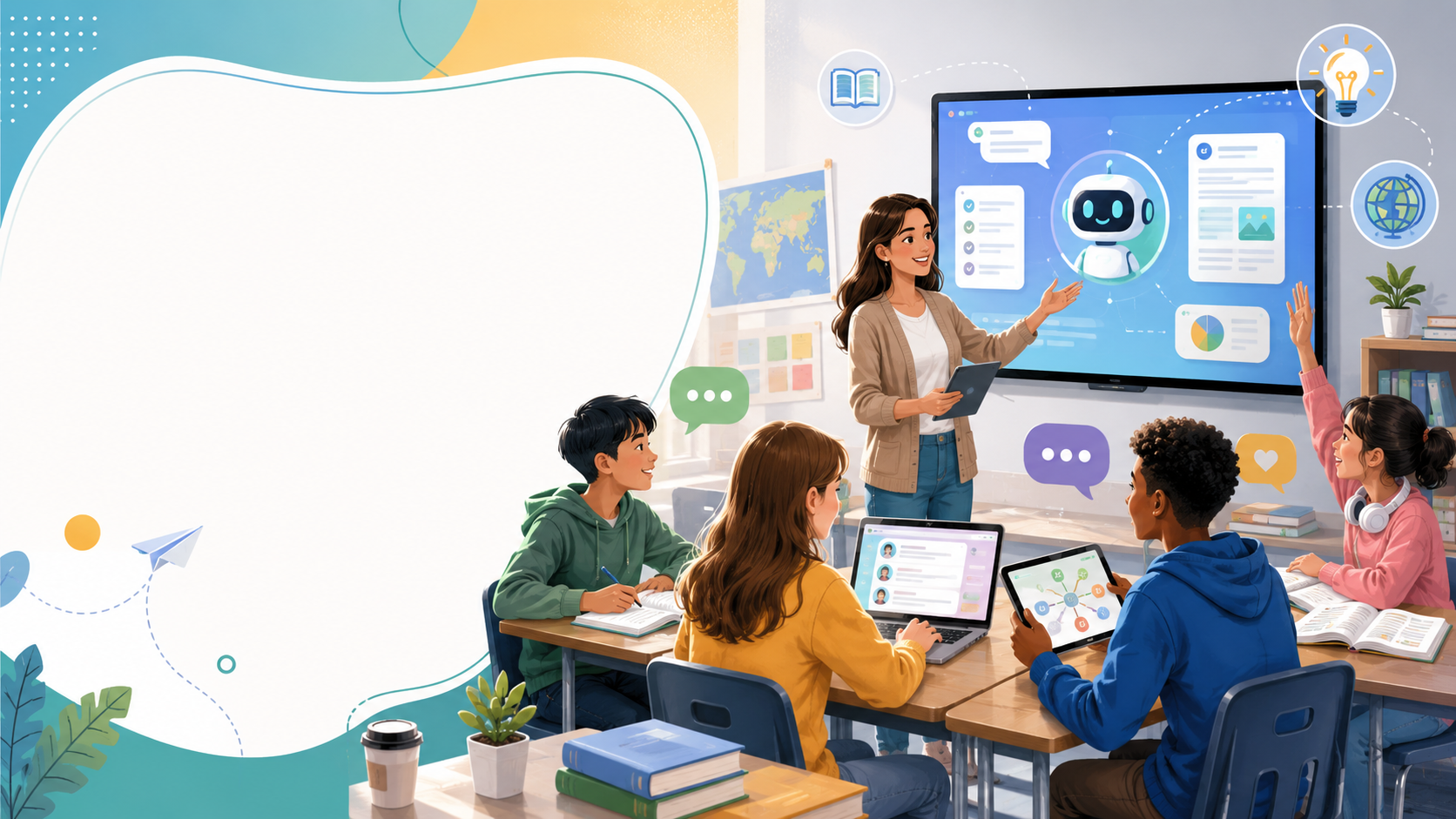
AI in the ESL classroom
How to Use AI Effectively in the Classroom: A Practical Guide for Teachers
Artificial intelligence is quickly becoming one of the most useful tools available to teachers. From creating lesson plans to generating classroom activities, AI can save time, provide new ideas, and help teachers personalize instruction.
But using AI effectively in the classroom requires more than simply asking a chatbot to “make a lesson.”
The best results happen when teachers use AI as an assistant, not as a replacement for good teaching.
What Does AI Mean for Teachers?
AI tools can analyze instructions and generate text, activities, questions, explanations, examples, and other educational materials in seconds.
For ESL teachers in particular, AI can be especially valuable because language instruction often requires teachers to create many different examples, exercises, dialogues, vocabulary activities, and levels of difficulty.
A teacher might use AI to:
-
Create lesson plans
-
Generate vocabulary exercises
-
Write reading passages
-
Develop discussion questions
-
Create quizzes and tests
-
Produce role-play activities
-
Simplify difficult texts
-
Generate writing prompts
-
Explain grammar concepts
-
Create differentiated activities for different English levels
The key is knowing how to give AI clear instructions.
1. Give AI Specific Instructions
One of the biggest mistakes teachers make is using prompts that are too general.
For example:
Weak prompt:
Make an English lesson.
AI has very little information about what you actually need.
A better prompt would be:
Create a 60-minute ESL lesson for 12 intermediate adult students about ordering food at a restaurant. Include vocabulary, a warm-up activity, a dialogue, pair practice, discussion questions, and a 10-question quiz.
The more information you provide, the more useful the result will usually be.
Consider including:
Student level: Beginner, intermediate, advanced
Age: Children, teenagers, university students, adults
Class length: 45 minutes, 90 minutes, three hours
Number of students: 5, 15, 30
Topic: Travel, business English, food, technology
Skills: Reading, writing, speaking, listening
Teaching goal: Vocabulary, grammar, conversation, test preparation
AI works best when you clearly describe the classroom situation.
2. Use AI to Create Different Levels of the Same Activity
One of the most powerful classroom uses of AI is differentiation.
Teachers often have students with different English abilities in the same classroom.
Instead of creating several activities manually, you can ask AI to adjust the same material.
For example:
Rewrite this reading passage at CEFR A2, B1, and B2 levels.
You could then give different versions to students depending on their ability.
AI can also simplify vocabulary, shorten sentences, add definitions, or make an activity more challenging.
This can help teachers support weaker students without holding back stronger students.
3. Create Conversation Activities
Many ESL students need more opportunities to speak English.
AI can quickly generate realistic classroom situations.
For example:
Create five role-play situations for intermediate ESL students practicing customer service English.
AI might generate scenarios involving:
-
Returning a product
-
Making a hotel reservation
-
Handling a restaurant complaint
-
Asking for technical support
-
Changing an airline ticket
Students can work in pairs and switch roles.
Teachers can then walk around the classroom, listen, provide corrections, and help students improve their communication.
4. Generate Discussion Questions
Teachers sometimes spend significant time thinking of good classroom discussion questions.
AI can help.
For example:
Create 10 discussion questions for intermediate ESL students about artificial intelligence and the future of work.
You can also specify that the questions should encourage longer responses rather than simple yes-or-no answers.
Good discussion questions can encourage students to:
-
Express opinions
-
Explain ideas
-
Agree and disagree politely
-
Practice new vocabulary
-
Develop critical-thinking skills
5. Use AI to Teach Vocabulary
AI can create vocabulary lessons extremely quickly.
For example:
Create a vocabulary lesson teaching 15 words related to hotels and hospitality. Include definitions, example sentences, fill-in-the-blank exercises, matching activities, and discussion questions.
Teachers can also ask AI to create vocabulary at a particular language level.
You might ask:
Explain these words using English that an A2-level student can understand.
This can be extremely helpful when teaching beginner and lower-intermediate students.
6. Create Reading Activities
AI can generate original reading passages based on almost any topic.
For example:
Write a 500-word reading passage for B1 ESL students about studying abroad. Include 10 vocabulary words, five comprehension questions, and three discussion questions.
Teachers can quickly create readings connected to student interests.
Topics might include:
-
Travel
-
Sports
-
Technology
-
Careers
-
Food
-
Culture
-
Business
-
Entertainment
-
Current events
However, teachers should always review AI-generated factual content before using it in class.
AI can occasionally make mistakes.
7. Create Writing Activities
AI can also help teachers develop writing assignments.
For example:
Create a writing activity for intermediate ESL students practicing persuasive writing. Include instructions, a sample outline, useful vocabulary, and a grading rubric.
Students could write about topics such as:
-
Should university education be free?
-
Should students be allowed to use AI for homework?
-
Is working from home better than working in an office?
-
Should cities invest more in public transportation?
Teachers can also use AI to generate model answers for classroom discussion.
8. Use AI for Grammar Practice
Grammar worksheets can take a long time to create manually.
AI can generate them in seconds.
For example:
Create 20 practice questions comparing the present perfect and simple past for intermediate ESL students.
Teachers can request:
-
Multiple-choice questions
-
Sentence corrections
-
Fill-in-the-blank exercises
-
Sentence transformations
-
Short writing activities
-
Conversation practice
You can also ask AI to explain grammar in simpler language.
For example:
Explain the difference between “since” and “for” to an A2-level ESL student using simple examples.
9. Create Quizzes and Review Games
AI can help teachers quickly create review materials.
For example:
Create a 20-question multiple-choice quiz based on this lesson. Include four answer choices and provide an answer key.
AI can also create:
-
True-or-false questions
-
Vocabulary games
-
Jeopardy-style questions
-
Trivia activities
-
Matching exercises
-
Review competitions
This can save teachers significant preparation time.
10. Let Students Use AI — But Teach Them How
Students are already using AI.
Simply banning AI may not prepare students for a world where AI tools are becoming increasingly common.
Instead, teachers can teach students how to use AI responsibly.
For example, students might use AI to:
-
Brainstorm essay ideas
-
Practice conversations
-
Ask grammar questions
-
Create vocabulary lists
-
Receive writing suggestions
-
Generate practice questions
But students should understand an important rule:
AI should help you think, not do all the thinking for you.
Students should still learn how to communicate, analyze information, solve problems, and express their own ideas.
11. Always Check AI-Generated Information
AI is powerful, but it is not always correct.
Teachers should review AI-generated materials before giving them to students.
Check:
-
Facts
-
Grammar
-
Vocabulary level
-
Cultural appropriateness
-
Instructions
-
Answer keys
Teachers should be especially careful when AI generates information about history, politics, science, laws, immigration, medicine, or current events.
Think of AI as a very fast teaching assistant.
It can prepare materials quickly, but the teacher remains responsible for the final lesson.
12. Protect Student Privacy
Teachers should also think carefully about privacy.
Avoid entering sensitive student information into AI systems unless your school has approved the platform and its use.
For example, instead of entering:
Correct Maria Lopez's essay. She is a student in my Tuesday class and has difficulty with...
Remove identifying information and simply write:
Correct this intermediate ESL student's essay and explain the five most important errors.
Teachers should follow their school's technology and privacy policies.
AI Will Not Replace Good Teachers
AI can create worksheets.
AI can generate vocabulary lists.
AI can write quizzes.
AI can suggest activities.
But AI cannot completely replace the human side of teaching.
Great teachers motivate students, understand their personalities, notice when they are confused, encourage them when they struggle, and create meaningful classroom relationships.
The future of education will probably not be teachers versus AI.
It will be teachers using AI effectively.
Teachers who learn how to use these tools may be able to spend less time creating repetitive materials and more time doing what matters most: teaching students.
Final Thoughts
AI is one of the most significant new tools available to educators.
The goal should not be to use AI for everything.
The goal should be to use it where it improves teaching.
Start small.
Try using AI to create one vocabulary activity, one reading passage, or one classroom discussion.
Experiment with your prompts.
Review the results.
Modify them for your students.
Over time, AI can become a valuable part of your teaching toolkit.
Looking for ESL Teaching Opportunities?
ESLBoards.com connects English teachers with teaching opportunities and resources around the world.
Explore ESL teaching jobs, career resources, and practical guides designed for today's English-language educators.
Visit ESLBoards.com and take the next step in your ESL teaching career.